Lesser Bladderwort
Utricularia minor
The lesser bladderwort (Utricularia minor) lives submerged in the water-filled ditches of peatlands. It has delicate leaves and, in summer, small yellow flowers that rise above the water surface. But its delicate appearance is deceptive. The lesser bladderwort is a carnivorous plant with highly efficient trap bladders. With them, it sucks in tiny crustaceans, insect larvae or rotifers that come too close — in a fraction of a second.
1 – Leaves
The leaves of the lesser bladderwort are strongly divided. This increases their surface area, making nutrient uptake and the exchange of carbon dioxide and oxygen easier.
2 – Shoots Instead of Roots
The lesser bladderwort does not produce roots. Instead, it anchors itself with mud shoots. It obtains nutrients through its trap bladders.
3 – Trap Bladders
Each leaf tip bears between two and ten trap bladders. They are used to suck in and digest prey.
4 – True size
The tangle formed by the lesser bladderwort is 10 cm across.
Family
Lentibulariaceae, bladderwort family
Genus
Utricularia, bladderwort
Distribution
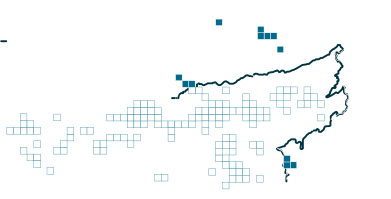
The lesser bladderwort occurs in the subarctic and temperate zones of the Northern Hemisphere, especially in Europe. In Austria, it is found in intact raised bogs, mainly in the Alpine region.
Threats and Conservation

As its habitats disappear, so does the lesser bladderwort (Utricularia minor). Human interventions such as the drainage of peatlands pose a threat. The plant and its rare to very rare habitats are protected under the Tyrolean Nature Conservation Regulation of 2006.
Acceleration in Comparison: From Free Fall to the Trap Bladders of the Lesser Bladderwort
1g
1 g or 9.81 m/s² corresponds to the acceleration due to gravity. It acts on an object in free fall without air resistance near the Earth’s surface. Under these conditions, a speed of 100 km/h is reached in 2.83 seconds.
2,9g
Acceleration record from 0 to 100 km/h for electric cars
4,1g
Maximum acceleration of a roller coaster, using the “Silver Star” at Europa-Park in Rust as an example
180g
Highest measured acceleration survived by a human, racing driver David Purley in 1977
300g
Maximum centrifugal acceleration in the spin cycle of washing machines
600g
The suction trap of the bladderwort breaks all records: its acceleration reaches 600 g and can only be made visible with high-speed cameras.