Northern Emerald
Somatochlora arctica
The northern emerald (Somatochlora arctica) often lives in Central Europe on quaking bog mats, floating vegetation mats on the water in peatlands. In small pools between cushions of peat mosses (Sphagnum spp.), the dragonfly larvae grow and develop. Their development takes two to three years. Only then do they transform into dragonflies. Instead of living in water, they now live in the air and on the ground. Because only a few individuals are usually found in any one place, the northern emerald is easily overlooked.
1 – Legs Forming a Catch Basket
With their six legs, dragonflies form a kind of catch basket and seize prey in flight.
2 – Wings
Dragonflies are fast fliers and excellent hunters. They use their four powerful wings, which are moved by strong muscles in the thorax.
3 – Compound Eyes
Dragonflies see with compound eyes made up of as many as 50,000 individual lenses. This allows them to perceive 300 images per second — six times as many as humans — and to react with lightning speed in the air.
4 – Appendages at the End of the Abdomen
During mating, the male holds the female with claspers at the end of the abdomen. The shape of these claspers differs from species to species, so males can attach only to females of the same species.
5 – True size
The northern emerald is 7 cm long.
Family
Corduliidae, emerald dragonflies
Genus
Cordulia, emerald dragonflies
Preferred Habitat
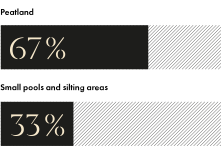
The distribution of the northern emerald is closely tied to intact peatlands.
Preferred Altitudinal Range

The northern emerald usually occurs at elevations between 650 and 950 metres and between 1,350 and 1,850 metres above sea level.
Agile and Fast Fliers
50 km/h
Dragonflies move effortlessly in all directions. They can even hover in the air like a helicopter. Added to this is their remarkable speed: dragonflies can reach up to 50 km/h, faster than most other insects.
Distribution
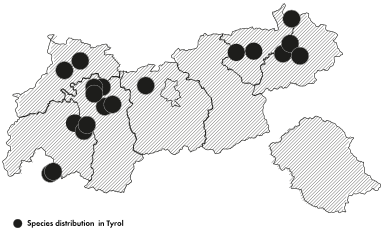
The northern emerald is a northern species ranging from Scotland to eastern Siberia. In Central Europe, it occurs in the Alps and the Alpine foreland. In Tyrol, it has been recorded at 27 locations.
Threats and Conservation

In Austria, the northern emerald (Somatochlora arctica) is listed as highly endangered on the Red List of threatened species.