Peat mosses
Sphagnum spp.
Peat mosses are true masters of survival under nutrient-poor conditions. They make use of the limited nutrients available in the peatland in two ways: in their living cells, they carry out photosynthesis, converting solar energy into chemical energy. In their dead cells and between their plant parts, they store water. That is why they feel like a sponge.
Peat mosses have no roots. Instead, they absorb nutrients through ion exchange across their cell walls. Everything they need to live comes from rainwater, animal droppings and dust carried to them by the wind.
1 – Capitulum
Peat mosses die off below and continue growing above. At the tip, the branches form a dense rosette.
2 – Branches
The branches of peat mosses grow in clusters along the stem. At regular intervals, two to seven branches occur together.
3 – Water Storage
Peat mosses have an enormous storage capacity. The water they retain weighs 17 to 30 times as much as the plants themselves.
4 – True size
The capitula of peat mosses are 1 cm across.
5 – From Green to Red
Peat mosses get their colour from pigments in their cell walls. Living cells are green, dead cells range from brown to bright red.
6 – Peat Formation
In peatlands, dead plant material is transformed into a special type of soil: peat. The peat layer grows very slowly, only about 1 metre in 1,000 years.
Family
Sphagnaceae, peat mosses
Genus
Sphagnum, peat moss
Species
14
in the peatlands at Piller Saddle
Important peat-forming species include Magellanic peat moss (Sphagnum magellanicum), reddish peat moss (Sphagnum rubellum), brown peat moss (Sphagnum fuscum), papillose peat moss (Sphagnum papillosum) and pointed-leaved peat moss (Sphagnum capillifolium). Fourteen species occur in the peatlands at Piller Saddle.
Fact
Distribution
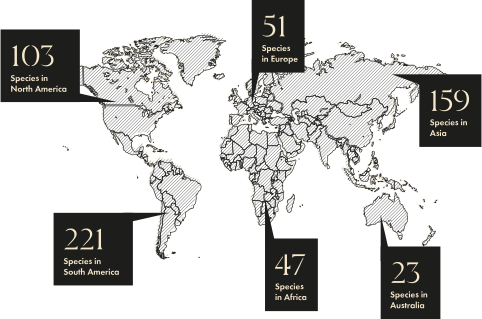
With the exception of Antarctica, peat mosses occur worldwide. They can be found in northern regions such as Canada and Siberia, in cool, wet mountain habitats, in the Amazon and the Congo, and on islands such as Ireland and Indonesia. They grow in nutrient-poor wetlands and near waters, forests and in the shade of rocks.
Threats and Conservation

Peat mosses depend on peatlands for survival. When peatlands are drained or degraded by peat extraction, they are displaced by other plants. Under the Tyrolean Nature Conservation Regulation, not only all occurring peat moss species are protected, but also their rare to very rare habitats.