Peatlands
Remarkable Carbon Stores
Peatlands grow slowly. Because oxygen is scarce, dead plant material decomposes only partially. The rest sinks to the bottom and forms the peat layer. Only 1 to 2 millimetres are added in a year. To reach a depth of 9 metres, as in the Piller peatlands, takes 10,000 to 12,000 years. Over this long period, peatlands become remarkable carbon stores. One third of the carbon held in all the world’s soils is stored in peatlands. Preserving them is therefore an important contribution to climate protection. Only as long as peatlands remain intact does this carbon stay out of the atmosphere.
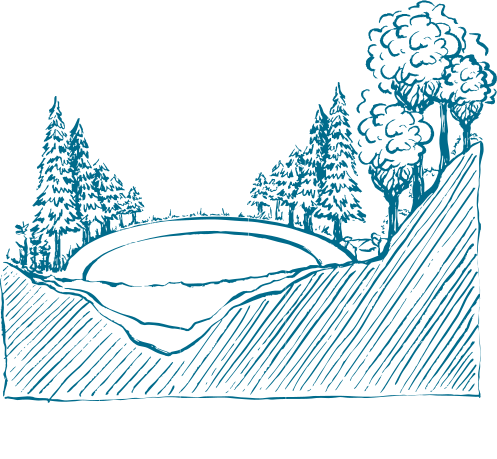
From Lake to Peatland
Peatlands form when a lake gradually silts up. Different plant remains accumulate as peat: sedge peat forms from reeds and grasses, sphagnum peat from peat mosses (Sphagnum spp.), and beneath them lies gyttja, a fossil underwater sediment.
Acrotelm and catotelm refer to the living upper and dead lower layers of the peat body. In the acrotelm, which is 0.5 to 1 metre thick, the water table fluctuates. In the catotelm, which can be up to 10 metres thick, the relationship between peat and water remains stable.
In the centre lies the treeless open expanse of the raised bog. The sloping outer zones are known as the marginal slope, while the wet zone at the edge is called the lagg.
Lorem Ipsum
Landbedeckung auf der Erde in Prozent
GLOBAL LAND COVER IN PER CENT

Kohlenstoffeinlagerung: Tonnen pro Hektar Lebensraum
CARBON STORAGE: TONNES PER HECTARE OF HABITAT

Anteil am weltweit gespeicherten Kohlenstoff in Prozent
SHARE OF GLOBALLY STORED CARBON IN PER CENT

Small Area, Big Impact
Peatlands cover only 5 per cent of the Earth’s land surface, yet they store more carbon than any other ecosystem. Per hectare, they store ten times as much carbon as natural grassland and twenty times as much as agriculturally used grassland.