Sundew
Drosera spp.
Where the soil offers only very limited nutrients, as it does in peatlands, nutritional specialists such as sundew (Drosera spp.) have an advantage over other plants. It obtains what it needs from animal food: nitrogen for growth and phosphorus for storing energy. This carnivorous plant bears movable, sticky tentacles on every leaf. When an insect lands on them, it becomes trapped. The leaf then curls around the insect and digests it.
1 – Nutrient Supply
The tentacles secrete enzymes that slowly break down the prey. The dissolved nutrients are absorbed through glands on the leaf surface.
2 – Gland Cells
Gland cells on the leaves secrete a sugary fluid (mucilage). The sparkling droplets and the bright colour of the leaves attract insects.
3 – Marginal Tentacles
The marginal tentacles of the leaf respond to touch and chemical stimuli. The leaf rolls itself around the insect.
4 – True Size
The sundew grows to 10 cm in height.
Family
Droseraceae, sundews
Genus
Drosera, sundew
Species
244
Of the 244 species worldwide recorded in 2018, three are native to Central Europe: round-leaved sundew (Drosera rotundifolia), great sundew (Drosera anglica) and oblong-leaved sundew (Drosera intermedia). All three species occur in the peatlands at Piller Saddle.
Distribution
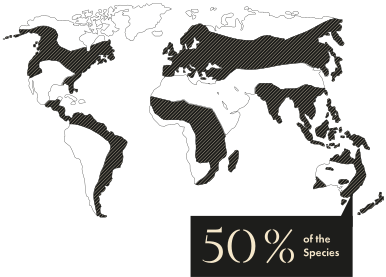
Sundews occur almost worldwide. Australia is the main centre of distribution, with more than 50 per cent of all species.
Threats and Conservation

On the Red List of threatened plants, oblong-leaved sundew (Drosera intermedia) is classified as endangered, while round-leaved sundew (Drosera rotundifolia) and great sundew (Drosera anglica) are considered potentially endangered. All sundew species, together with their rare to very rare habitats, are protected under the Tyrolean Nature Conservation Regulation of 2006.
Strong Stuff: Adhesive
The glandular hairs of carnivorous plants produce remarkably sticky substances. Their adhesive strength is four times greater than that of flypaper. These natural glues are being studied scientifically in order to develop new kinds of binding materials.