Large Blue
Phengaris arion
For the large blue (Phengaris arion), mountain meadows are the only true place to live. This is where thyme and oregano grow — the first “baby food” of the caterpillars. And this is also where their “foster parents”, the red meadow ants, live. To get into an ant nest, the caterpillars drop to the ground and imitate the scent of ants — and are promptly carried inside. In the nest, they feed on the ants’ brood, pupate, and finally emerge as shimmering blue butterflies. It is an ingenious strategy, but it also makes the species highly dependent: on mountain meadows with thyme, oregano and red meadow ants.
1 – Neatly Ringed
The antennae of blues are ringed in black and white and are usually about half as long as the forewings.
2 – Well waxed
As soon as they hatch, the butterflies must leave the ant nest quickly, otherwise they will be eaten by the ants. They gain time thanks to a waxy coating on their wing scales: while the ants are irritated by the wax, the butterflies escape.
3 – Structurally Coloured
The blue of the wings is produced by the structure of the scales.
4 – True size
The wingspan of the large blue is 4 cm.
Baby Food
Large blues lay their eggs between the leaves of broad-leaved thyme and oregano — directly in the caterpillars’ food store for their first weeks of life.


Winter food

In winter, the caterpillars of the large blue (Phengaris arion) feed on ant brood. In spring, they pupate.
Family
Lycaenidae, blues
Genus
Phengaris, large blues
Distribution
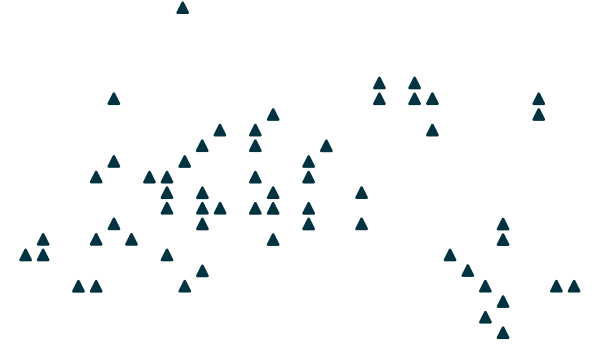
The large blue occurs in the tri-border region of Austria, Germany and Switzerland, as well as in France, and more sporadically in East Asia. In Tyrol, it has been recorded in several regions. In Naturpark Kaunergrat, it is native to higher-elevation mountain meadows.
Threats and Conservation

The large blue (Phengaris arion) survives only in managed dry grasslands and mountain meadows. Where mowing on mountain slopes ceases, it is at risk of disappearing. The EU classifies it as an Annex II species of the Habitats Directive, for whose conservation protected areas must be designated.