“All meadows and pastures, all mountains and hills are pharmacies.”
Attracting insects, outshining other plants and getting rid of ravenous predators — flowering plants achieve all this through colours, scents and other chemical substances. Humans make use of these secondary plant compounds, for example by extracting them with water or oils, or by using entire plant parts. In this way, the flower-rich meadow becomes both a spice rack and a pharmacy.
Arnika
Arnica Montana
Family: Asteraceae
Main active compounds: essential oil, sesquiterpene lactones (for example helenalin), flavonoids, coumarins, xanthophylls, polysaccharides
Use: The flowers of the plant (Arnicae flos) contain the compound helenalin. It has antimicrobial, anti-inflammatory and pain-relieving effects.
Arnica is protected and must not be collected in the wild.
Broad-leaved Thyme
Thymus Pulegiodes
Family: Lamiaceae
Main active compounds: essential oil, bitter compounds, flavonoids, tannins, triterpenes
Use: The above-ground parts of the plant (Thymi herba) are valued as a spice because of their intense aroma.
Thyme is also used as a medicinal plant for stomach and respiratory complaints, especially common thyme (Thymus vulgaris).
Yarrow
Achillea Millefolium
Family: Asteraceae
Main active compounds: essential oil, sesquiterpene lactones, flavonoids, tannins, coumarins
Use: The above-ground parts of the plant (Millefolii herba) have anti-inflammatory, antispasmodic, antimicrobial and digestion-promoting effects.
Yellow Gentian
Gentiana Lutea
Family: Gentianaceae
Main active and other constituents: secoiridoid glycosides (bitter compounds), various sugars
Use: The bitter compounds with which yellow gentian protects itself against grazing animals stimulate the appetite in bitters and aperitifs. Gentian spirit made from the roots is a popular digestif.
Monkshood
Aconitum Napellus
Family: Ranunculaceae
Toxic compounds: alkaloids, especially a complex of diterpene and norditerpene alkaloids such as aconitine
Poisoning: Aconitine is absorbed through the skin and, even more readily, through mucous membranes. For this reason, simply touching the plant — for example by playing children — can already pose a risk of poisoning.
Lethal dose for adults: 2–5 mg aconitine or 1–2 g of the dried tuber
All monkshood species are listed as partially protected plants in Tyrol.
White Hellebore
Veratrum Album
Family: Liliaceae
Toxic compounds: steroid alkaloids, especially in the rhizome and roots
Poisoning: Veratrum alkaloids are rapidly absorbed both through mucous membranes and through intact skin.
Lethal dose for adults: 10–20 mg of the alkaloid mixture or 1–2 g of the dried root
Plant Species
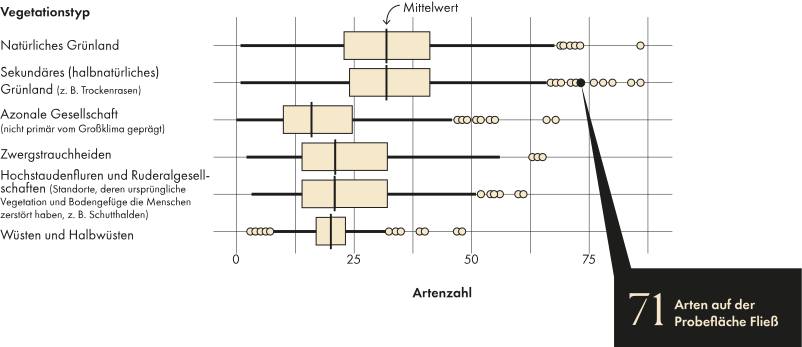
Naturpark Kaunergrat is home to especially species-rich mountain meadows. During a research expedition by the Eurasian Dry Grassland Group (EDGG) in July 2018, 71 and 66 plant species were recorded on two sample plots of 10 m² each. This is an Austrian record. The European average for natural or semi-natural grassland is around 40 species.
Threats and Conservation

Species-rich mountain meadows are considered endangered to highly endangered in Austria and within the European Union. In the EU Habitats Directive, they are listed as natural and semi-natural habitat types of Community interest.