Apollo butterfly
Parnassius apollo
The Apollo butterfly (Parnassius apollo) likes it sunny, hot and dry — just like Mount Parnassus, which in Greek mythology was sacred to the god Apollo. These butterflies live among scree and rock, on dry grasslands and nutrient-poor grasslands, on stone walls and on spoil heaps from quarries. The decisive factor is the availability of food. The caterpillars of the Apollo butterfly need white stonecrop (Sedum album), while the adult butterflies depend on blue- and violet-flowering nectar plants such as small scabious (Scabiosa columbaria), oregano (Origanum vulgare) and spiny plumeless thistle (Cirsium spinosissimum). If open land becomes overgrown, these plants disappear — and with them the Apollo butterfly.
1 – Antennae
Unlike other Parnassius species, the antennae of the Apollo butterfly are uniformly grey with black clubs.
2 – Hindwings with Eyespots
The red eyespots (ocelli) on the hindwings, outlined in black and with a white centre, are larger in females than in males. They warn predators of the butterfly’s toxicity.
3 – Scales
The droplet-shaped wing scales, arranged like roof tiles, provide the butterfly’s colouration and offer good protection against UV radiation.
4 – True size
The Apollo butterfly has a wingspan of 6 to 9 cm.
Egg
The female lays the white, rounded, granulated eggs into white stonecrop (Sedum album). Inside its preferred food plant, the caterpillar overwinters in the egg and hatches in spring.
Caterpillar
The caterpillars feed on white stonecrop and sometimes on houseleek. They also sun themselves on the plant.
Mummy Pupae
The dark brown pupae are covered with a bluish bloom.
Family
Papilionidae, swallowtails
Genus
Parnassius
Distribution
Originating from the Siberian-Mongolian region, the Apollo butterfly spread across Europe and Asia from Spain to China. Of th 600 Parnassius species, only six occur in Austria, mostly at elevations from 1,000 to a maximum of 2,000 metres above sea level.
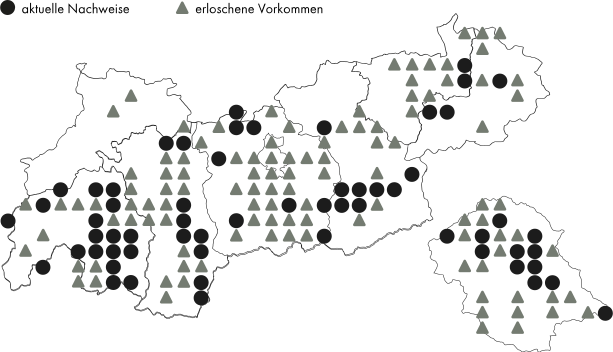
Distribution in Tyrol Since 1949
The Apollo butterfly is now found more often in Naturpark Kaunergrat than 75 years ago. At former sites, such as in the Inn Valley and the Wipp Valley, it can hardly be recorded today. In Naturpark Kaunergrat, where measures are being taken to preserve biodiversity, it is now more common than it was 75 years ago.
Threats and Conservation

As open habitats become overgrown with scrub or are afforested, the Apollo butterfly loses large parts of its habitat. The use of herbicides in agriculture also affects this species. In Europe, the Apollo butterfly is therefore highly threatened and strictly protected.