Dung Beetles
Onthophagus gibbulus
Livestock produces dung — goats and sheep, cattle and horses, in short, everything that grazes on mountain pastures. But the droppings do not lie there for long. Dung beetles spread and bury them so that bacteria and fungi can break them down. Nutrients from the dung become fertiliser for seedlings, grasses and flowers. Parasites, by contrast, lose their basis for survival, and grazing livestock stays healthier. In the dry grassland ecosystem, dung beetles are therefore just as important as pollinators.
1 – Pronotum
The black pronotum slopes steeply towards the head.
2 – Horn
Males carry an S-shaped horn.
3 – Antennae
The antennae are fanned out like a leaf.
4 – Forelegs
The broadened forelegs are used for digging tunnels.
5 – Wings
The wing covers are golden brown with black speckles.
6 – True size
Onthophagus gibbulus reaches a body length of 0.8 to 1.5 cm.
Family
Scarabaeidae, scarab beetles
Genus
Onthophagus, dung beetles
Nursery in a Dung Heap
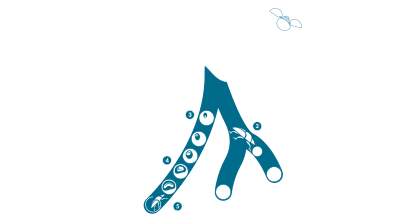
1. Adult dung beetles of the species Onthophagus gibbulus feed on dung heaps and also mate there.
2. After mating, female beetles dig tunnels beneath the heap and deposit dung at the ends.
3. From the dung, the females form a brood ball with a brood chamber for each egg. They place the egg inside together with some of their own faeces.
4. Bacteria from the female’s faeces colonise the egg and the larva. These bacteria later enable the animals to digest dung themselves.
5. After three larval stages, the larvae pupate, become beetles within eight days, and hatch when environmental conditions are favourable.
Source: Anne M. Estes et al., Brood Ball-Mediated Transmission of Microbiome Members in the Dung Beetle, 2013.
Distribution
140
Species in Central Europe
Dung beetles occur in Europe, Asia and North Africa and were introduced to North America. Around 100 dung beetle species occur in Austria.
Use, Spread, Bury

Different dung beetle species do their dirty work in different ways: dwellers feed directly in the dung heap. Tunnelers, such as Onthophagus gibbulus, dig passages beneath the heap and distribute dung balls there. Rollers shape small balls and store them as food for their offspring.
Threats and Conservation

For dung beetles, only solid dung is good dung: cow pats, horse droppings or sheep pellets are their raw material. If slurry or liquid manure is spread widely over a field, the beetles can no longer detect the dung heaps. Depending on the species, dung beetles are threatened to very different degrees. Onthophagus gibbulus is considered endangered in western Austria and extinct in Bavaria and parts of eastern Austria.