Grasshoppers
Orthoptera
The order Orthoptera is divided into long-horned grasshoppers and short-horned grasshoppers. Some have long antennae and long hind legs, are active at night and feed on both plant and animal matter. Others have short, thick antennae, are active by day and feed only on plants. Grasshoppers are widespread, but they are particular in their choice of habitat. They occupy many different habitats, from valley floors to the edges of glaciers. Because they respond sensitively even to small environmental changes, their presence or absence shows how a site is doing.
Great Knob Grasshopper
Arcyptera fusca
The great knob grasshopper (Arcyptera fusca) is a short-horned grasshopper. It lives in short, dry, warm nutrient-poor grasslands with patches of open ground. Males are 2.2 to 3 cm long, females 2.9 to 4.2 cm.
1 – Eyes
On the head are two large compound eyes and three inconspicuous simple eyes.
2 – Mouthparts
Grasshoppers can bite and chew with their feeding mouthparts.
3 – Hearing
Like humans, grasshoppers have eardrums for hearing. They carry them either on the sides of the body or on the forelegs.
4 – Jump
Grasshoppers jump by extending the joint of the hind leg. To do so, they use muscular force or deform their exoskeleton like a spring.
5 – True size
The largest female great knob grasshoppers reach 4.2 cm in length — twice the size of the smallest males.
From Egg to Grasshopper
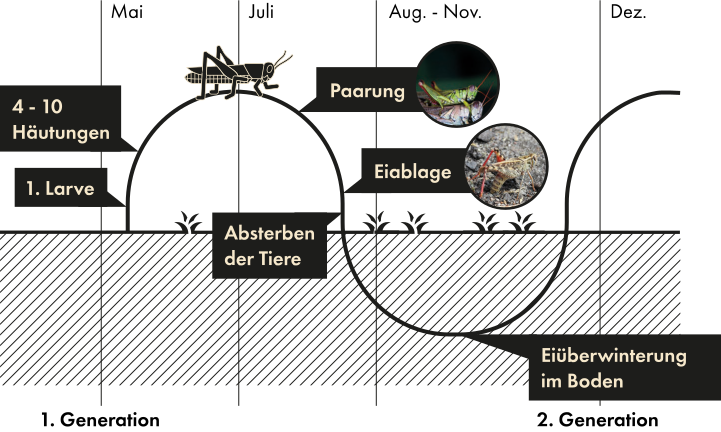
In spring, the smaller males court females with loud chirping, rubbing their legs or wings together. The female lays a few hundred eggs, placing them with her ovipositor (in long-horned grasshoppers) or with her abdomen (in short-horned grasshoppers) in the soil, in plant stems or in the bark of trees. Only after one to five years do small grasshoppers hatch — still without wings. As they grow, they moult several times, but they do not pupate.
Family
Acrididae, short-horned grasshoppers
Genus
Arcyptera
Distribution
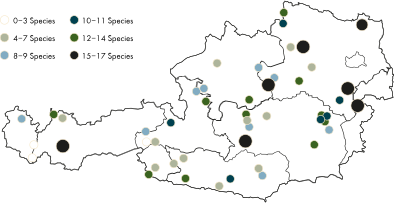
Of the 28,000 grasshopper species worldwide, only 0.5 per cent occur in Austria — that is, 64 species of long-horned grasshoppers and 76 species of short-horned grasshoppers. One of these is the great knob grasshopper, and one third of all individuals occur in western Tyrol. Individual specimens have been found at elevations of up to 2,208 metres above sea level. Most occur between 1,000 and 1,600 metres.